As global construction and home furnishing markets continue to upgrade, Wood-Plastic Composite (WPC) doors—valued for moisture resistance, corrosion resistance and eco-friendliness—are gaining ground in the Middle East, Europe and beyond. At the same time, customer demand is shifting from “standard supply” to “personalized customization.”
This raises a core question: how can an automated WPC door production line achieve personalization? The answer lies in a blend of flexible design, digital control and automated surface treatment.
1. Personalization Becomes the Market Mainstream
Across Middle-Eastern and European projects—residences, apartments, hotels, commercial complexes—buyers frequently request:
-
Different door sizes & structures
-
Varied surface textures, colors & decorative effects
-
Door frames & architraves matching overall space styles
-
Fire-proof, moisture-proof or other special functions
Traditional batch production struggles to meet these variations without sacrificing speed. Automated lines, however, turn customization into a competitive advantage.
2. Flexible Architecture – the Technical Foundation
Modular design allows the line to:
-
Switch door-type parameters in minutes
-
Run multi-spec doors & frames in parallel
-
Handle small-lot, multi-variety orders efficiently
This flexibility lets manufacturers accept bespoke projects while maintaining capacity—ideal for engineering contractors and regional distributors.
3. CNC & Digital Control Ensure Accuracy
CNC machining centers and intelligent control systems:
-
Convert CAD drawings directly into cutting programs
-
Drill, mill and engrave doors digitally to ±0.2 mm
-
Store hundreds of door recipes for instant recall
Data-driven production shortens lead times and guarantees consistent quality across custom batches.
4. Automated Surface Treatment Meets Aesthetic Demands
Auto surface-finishing modules provide:
-
On-line lamination (wood grain, marble, solid color)
-
Texture embossing (synchronous pore, hand-scraped, high-gloss)
-
Quick-change film & roller magazines for color switching in 3 minutes
WPC doors thus retain their technical advantages while offering richer visual effects to suit diverse national preferences.
5. From “Manufacturer” to “Solution Provider”
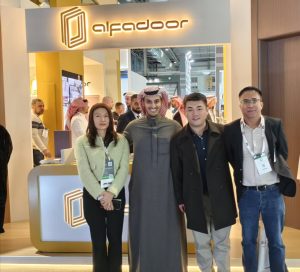
This is particularly evident in actual market communication.It’s also a very pleasant thing to reunite with old friends from Alfa Door Industry and have a casual chat. At trade fairs like Big 5 Riyadh, customers increasingly say: “We don’t just want machines; we want long-term capability for customization and market change.”A mature automated WPC door line delivers exactly that—design, equipment, software and after-sales integrated into one responsive package.
6. Long-Term Value of Customization Capability
Benefits include:
-
Higher order-matching rate
-
Stronger project competitiveness
-
Stable, repeatable quality
-
Easier entry into premium & engineering segments
For suppliers targeting the Middle East and Europe, this capability is fast becoming a core competitive edge.
Conclusion: Automation is the Lever for Personalization
Personalization does not mean sacrificing efficiency—it demands the right automated WPC door production line.
Through flexible structures, digital controls and automated surface technologies, WPC door manufacturing is shifting from “standard production” to “smart customization.”
Through flexible structures, digital controls and automated surface technologies, WPC door manufacturing is shifting from “standard production” to “smart customization.”
Companies that integrate automation and personalization deeply will build stronger, longer-lasting relationships in international markets.