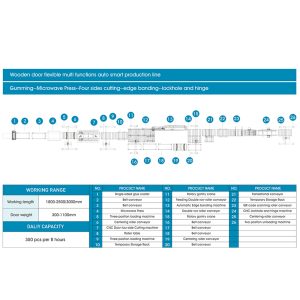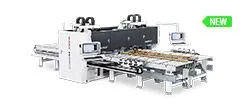
Core Technologies Behind Automated Wooden Door Production Lines
A B2B Perspective for the European and Middle East Markets
As the construction and interior fit-out industries continue to grow across Europe and the Middle East, the demand for high-quality, customized wooden doors is increasing steadily. Manufacturers are under pressure to deliver consistent quality, shorter lead times, and cost-efficient production while complying with strict safety and environmental standards.
In this context, automated wooden door production lines have become a strategic investment rather than an optional upgrade. Understanding the core technologies behind these production lines is essential for manufacturers planning capacity expansion or production modernization.
CNC Machining Technology: Precision as a Production Standard
At the foundation of any automated wooden door production line lies CNC machining technology. CNC routers and machining centers are responsible for cutting, drilling, grooving, and profiling door panels and frames with high accuracy.
For European and Middle Eastern markets, where dimensional tolerance and finishing quality are strictly controlled, CNC technology offers:
-
Consistent precision across large production volumes
-
Compatibility with different door designs and specifications
-
Reduced material waste and rework
This level of accuracy is particularly important for export-oriented manufacturers serving commercial, residential, and hospitality projects.
Intelligent Control Systems: Centralized and Reliable Automation
Modern automated wooden door production lines rely on PLC-based control systems combined with industrial automation software. These systems act as the central coordination layer, ensuring smooth interaction between all machines in the line.
Key benefits include:
-
Stable and continuous operation
-
Real-time monitoring and fault diagnostics
-
Easy integration with MES or ERP systems
For manufacturers operating in Europe and the Middle East, intelligent control systems also support traceability, compliance documentation, and production transparency, which are increasingly required by large contractors and developers.
Robotic Handling Systems: Improving Efficiency and Workplace Safety
Labor availability and cost remain critical concerns in both European and Middle Eastern markets. Robotic handling systems are therefore a core technology in automated wooden door production lines.
Robots are commonly used for:
-
Panel loading and unloading
-
Transfer between processing stations
-
Stacking and packaging
By automating these tasks, manufacturers benefit from:
-
Lower labor dependency
-
Improved production stability
-
Enhanced workplace safety
Robotic solutions are especially valuable in high-volume production and multi-shift operations.
Automated Surface Processing and Finishing Technology
Surface quality plays a decisive role in wooden door acceptance, particularly in premium residential and hospitality projects common in Europe and the Middle East.
Automated wooden door production lines integrate:
-
Automatic sanding systems with uniform pressure control
-
Environmentally friendly coating and finishing systems
-
Controlled drying and curing technologies
These solutions ensure consistent appearance, long-term durability, and compliance with EU environmental and VOC regulations, as well as regional sustainability requirements.
Flexible Manufacturing Systems for Custom and Project-Based Orders
Customization is no longer a niche requirement. In both Europe and the Middle East, projects often demand non-standard sizes, designs, and finishes.
Flexible manufacturing technology enables automated wooden door production lines to:
-
Switch between different door models efficiently
-
Handle small-batch and project-based orders
-
Maintain high productivity despite product variation
This flexibility allows manufacturers to serve architects, contractors, and developers more effectively without increasing operational complexity.
Intelligent Quality Inspection and Process Control
Quality consistency is critical for international markets. Automated wooden door production lines increasingly use sensor-based and vision inspection systems to monitor key parameters during production.
These systems help manufacturers:
-
Detect defects at an early stage
-
Reduce scrap rates
-
Ensure stable compliance with international quality standards
For B2B buyers in Europe and the Middle East, this level of quality control translates into higher trust and long-term partnerships.
Energy Efficiency and Sustainable Production Technologies
Energy efficiency and sustainability are now key decision factors for equipment investments. Automated wooden door production lines integrate:
-
Energy-efficient motors and drives
-
Optimized dust extraction and waste management systems
-
Material utilization and recycling solutions
These technologies support manufacturers in meeting European sustainability goals and regional environmental regulations while reducing operational costs.
Conclusion: Technology as a Competitive Advantage
The performance of an automated wooden door production line depends on the integration of multiple core technologies—from CNC machining and intelligent control systems to robotics, flexible manufacturing, and sustainable solutions.
For manufacturers targeting the European and Middle Eastern markets, investing in advanced automation is not only about productivity. It is about:
-
Meeting international quality expectations
-
Supporting customization and project-based production
-
Ensuring long-term operational stability and compliance
As global competition intensifies, automated wooden door production lines equipped with the right technologies provide a clear and sustainable competitive advantage.